We remember Super Bowls for one of two things: the performance by the two teams or the performance by the music artist at halftime. Super Bowl LIX was no different. For years to come, football fanatics will remember the Philadelphia Eagles’ dominating fashion in denying the Kansas City Chiefs a third consecutive championship. However, what fans and spectators might remember most from the big game in New Orleans is Kendrick Lamar’s halftime performance.
The league first announced Lamar as the Super Bowl halftime performer in September to promote the start of the season. The announcement comes with overwhelming hype and anticipation for what Lamar would do. Not just because so many people regarded Lamar as one of the best lyricists in the game but also because of the ongoing feud between him and Drake. The subtle (and not-so-subtle) shots fired back and forth have been well-documented over the years, with the most volatile connecting months before the NFL’s announcement in Lamar’s “Like That” track with Future and Metro Boomin’. This collaboration ignited the latest chapter in the exchange between the two artists, which came to a head when Lamar accused Drake of, well, being a pedophile. So, the question was, what would fans expect from Lamar’s halftime performance?
PRESS START
With the Eagles headed for the locker room at halftime, nursing a 24-0 lead, the Cesar Superdome was left deflated. Many anticipated a far more compelling and competitive rematch between the two teams. Thankfully for everyone involved, Lamar’s halftime show rekindled the dying embers among the crowd. The overhead stadium lights grew dark, and tiny sparkles began to pop in the stands like a loading bar. Giant letters light up in alternating sequences on the field as the bar fills up. When the bar is complete, we’re greeted by the familiar voice and face of Samuel L. Jackson. Donning a full three-piece red, white, and blue suit (complete with the matching top hat and bow tie), Jackson acts as our mediator, so to speak. Jackson’s performance as Uncle Sam mirrored his performance in Spike Lee’s CHI-RAQ, which the director took to Instagram to share his thoughts as well.
As Jackson finishes his introduction, the tiny sparkles in the stands start forming two words with an arrow pointed down: START HERE.

As the camera pans, we see the arrow pointing to Lamar kneeling on the hood of a GNX. While Lamar is rapping part of an unreleased song, dancers in red, white, and blue tracksuits start pouring out of the car. The beat quickly changes after the last of the dancers are on the stage. With the light shining on him, Lamar speaks into the microphone.
“The revolution’s about to be televised; you picked the right time but the wrong guy.”
Let’s take a pause here and analyze this line. This line sounds like something someone like Lamar would say until you find out; this is a revised line from Gil Scott-Heron’s “The Revolution Will Not Be Televised.” Scott-Heron’s song depicts the relationship between the general public and the media and how much influence the media has on what the public sees. If protests or atrocities were happening in the streets, and if you don’t go outside, who’s to say the news would show you the truth? By reversing the line and instead saying the revolution will be televised, Lamar is telling us that we capture and share the truth. More and more raw footage of natural disasters or genocides is popping up on social media platforms that offer far more investigative angles, like Twitch political streamer Hasan Piker interviewing inmates fighting the California fires for pennies. Lamar saying it’s the “right time but the wrong guy” could be directed at electing Donald Trump.
Who Built America?
One observation that many viewers had after Lamar’s performance was the absence of mayonnaise among the dancers. While this observation is accurate, it’s pretty amusing to consider these individuals fuming about DEI. Following Squabble Up, the camera panned back to Jackson with some criticism for the performer. Jackson shook his head profusely and called the performance “too loud, too reckless, too ghetto.” He asked if Lamar really knew how to play the game and to tighten up.
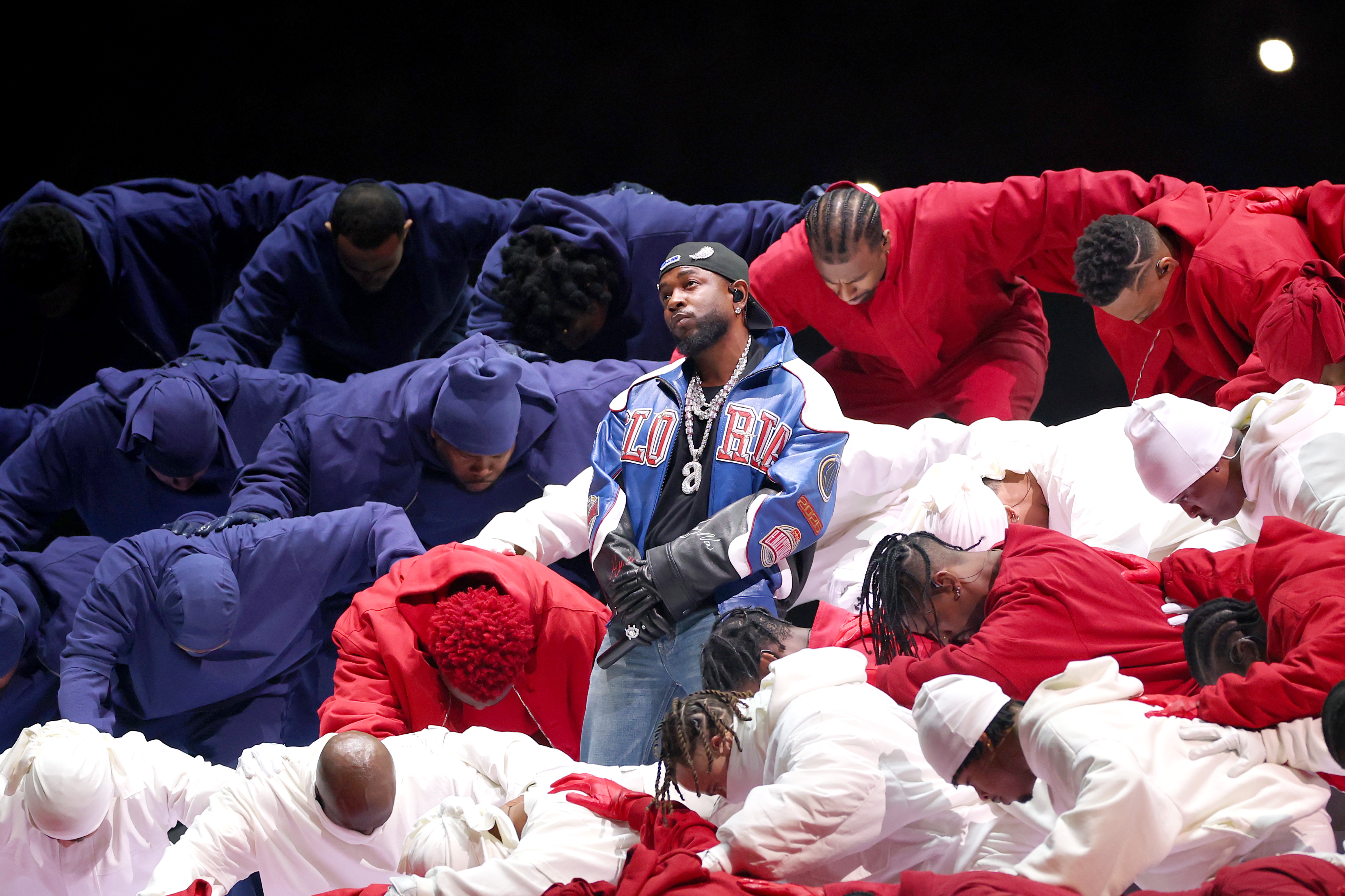
When the camera shifts back to the main stage with Humble playing in the background, we see Lamar in the center of the American flag. But it’s not a cloth flag; it is made of the dancers. As the beat drops again, the flag splits down the middle, leaving Lamar in an open middle aisle. By now, viewers can quickly identify Lamar’s chain as “a minor.”

In the choreography, the performers’ movements are noticeably rigid and uniform. The strict formations imply obedience and conformity because “Humble” plays in the background. The flag, split down the middle, evokes the notion of a divided nation, a fractured country. One specific shot of Lamar standing in the middle aisle with the two sides bent forward has profound significance.
The Black performers bent over as the flag represented the fundamental truth that America was built on the backs of enslaved Black people—everything from infrastructure to buildings and streets. The shot also represents America currently being lifted on the backs of Black people, particularly incarcerated people. The prison system has effectively turned its inmates into modern-day enslaved people, paying them pennies and not offering any benefits for life post-release.
Special Guest
Lamar continued to electrify the crowd with DNA and Euphoria before taking it down a notch in Man at the Garden. After playing Peekaboo, Lamar tells four dancers that he wants to “perform their favorite song, but you know they love to sue,” throwing a shot at Drake for filing a lawsuit against Universal Music Group for defamation. Yes, Drake sued the record label and not Lamar himself.

Choosing to slow things down, Luther begins to play. Lamar fans will know this song features a guest singer, and sure enough, SZA appears on the stage. Luther transitions into another song by the pair: All the Stars. Made popular by the Marvel film “Black Panther,” All the Stars also features a scathing attack directed toward Drake following the first chorus. But because the majority of the crowd and listeners attribute All the Stars to Black Panther and Marvel, everyone’s cheering and having a good time. Uncle Sam joins the cheers, says this is what America wants, and tells Lamar not to mess things up before being cut short by the Not Like Us beat.
Kendrick Ults Drake
The four dancers from earlier show up again, and Lamar says there is a cultural divide. They ask him if he’s really going to do it, and he responds, “40 acres and a mule—this is bigger than the music.”
Before we continue into Not Like Us, let’s talk about 40 acres and a mule.
Back in 1865, General William Tecumseh Sherman issued a special order to allocate confiscated Confederate land to formerly enslaved people, specifically 40-acre plots. The special order was viewed as reparations for the many decades of slavery. However, following the assassination of Abraham Lincoln, President Andrew Johnson overturned the special order and denied newly freed Black slaves their reparations. Instead, Johnson gave the land back to former slave owners to soften the blow of losing their now-freed slaves.
The dancers ask again if he’s gonna do it, and he responds, “Yeah, they tried to rig the game, but you can’t fake influence.” And then, we finally get into Not Like Us.
Lamar shuffled toward the camera with the four dancers flanked behind him until it panned overhead. The new angle showed all the other dancers in the red, white, and blue tracksuits. The camera switches back to Lamar briefly, then goes back to the overhead view as most dancers collapse and purposefully sprawl their limbs on the ground. A few bodies simply look like cartoonish dead bodies, but several sprawled-out performers resembled swastikas. It’s easy to correlate that messaging to the rising levels of fascism in America behind the re-election of Trump.

As the song continues, we get an aerial shot with the GNX in the upper left of the screen. There, you can see the protestor waving a Palestinian-Sudanese flag sewn together to protest the genocides occurring in Palestine and Sudan. The camera switches back to Lamar and then to another special guest, Serena Williams, crip walking on a platform. The protestor can still be seen waving the Palestinian-Sudanese flag behind Williams a few more times before we finally settle back on Lamar.
That’s All, Folks
The final song in Lamar’s halftime performance is TV Off featuring Mustard. After the show, Lamar confirmed that the symbols on stage were meant to be PlayStation symbols and that he wanted to turn his life into a video game. The early message in the lights to start the show, “START HERE,” is also an homage to video games. Ending the show with TV Off is like Lamar literally telling the audience to turn their TVs off because the show is over. A final message can be seen in the crowd saying, “GAME OVER.”
Ultimately, Lamar’s Super Bowl performance was incredibly entertaining and easily the highlight of an otherwise uneventful finale to the NFL campaign. Naturally, online groups criticized Lamar’s halftime performance, some calling it the “worst show ever.” That’s a crazy thing to say when the NFL has had “It’s a Small World” before.
On the other hand, liberals and patriot-pilled freaks were kissing Lamar’s feet for his American propaganda and for worshipping the flag. This only speaks volumes about their lack of media literacy and willingness to distort critical and meaningful things. Lamar’s performance was full of several in-your-face metaphors and symbols that depicted a country falling apart, a country with oppressed and mistreated people. Whether you believe Lamar’s performance could have been more revolutionary, it was, without question, the most revolutionary and politically-fueled performance in Super Bowl history.
Leave a Reply