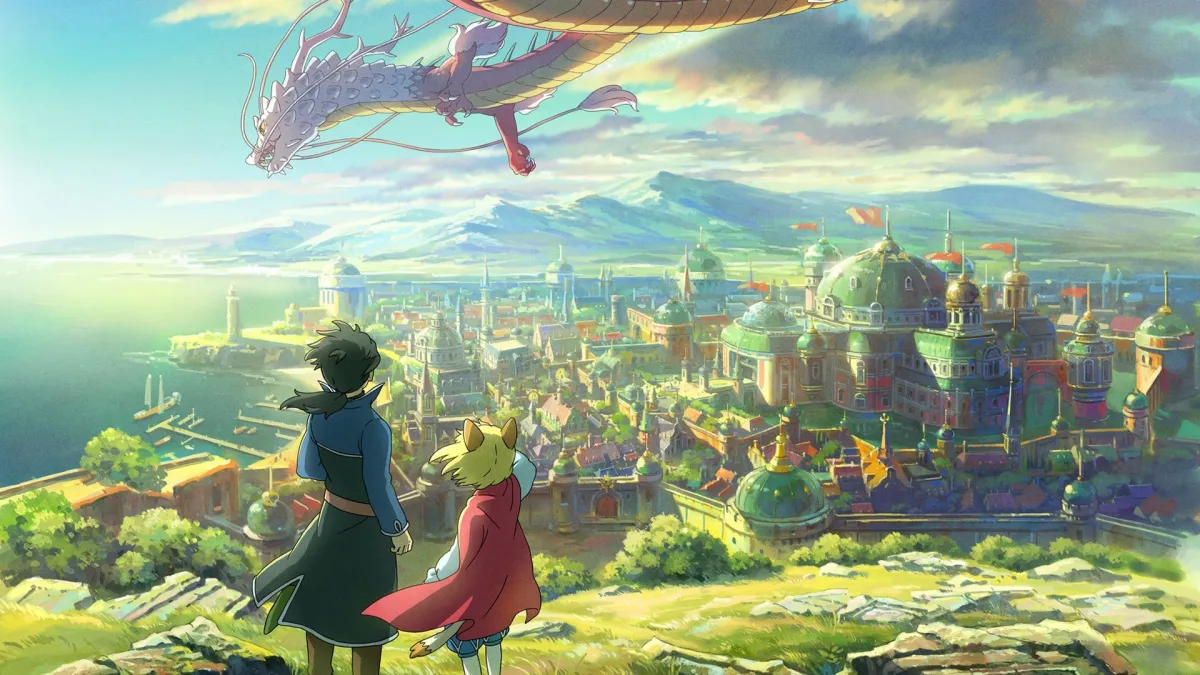
Recently, I was properly introduced to the wonderful world of Studio Ghibli (by my dentist, go figure). Movies such as Spirited Away, My Neighbor Totoro, and Howl’s Moving Castle completely blew me away. Hayao Miyazaki’s films are charming, full of deep moving stories, and contain amazing character development. I wanted more from the worlds he created, I wanted to immerse myself in them. That’s when I noticed Ni no Kuni II.
Having not played the first installment, I was pleased to find out that the sequel was an adventure all of its own, but did have some small references from the original game. At first glance, Level-5’s JRPG is exactly what I was looking for: a world that resembled Studio Ghibli. Ni no Kuni II is absolutely beautiful. The colors are vibrant and the art design is gorgeous. Plenty of times during my near 40-hour play-through, I thought this was another one of Miyazaki’s creations and not a video game. And just like a Studio Ghibli film, Ni no Kuni II presented a fairly interesting story and an extraordinary wide cast of characters that you truly care about. However, looking passed the pretty shine and the lovable characters is a game that struggles to find its identity.
Ni no Kuni II follows the story of young King Evan, or soon-to-be King Evan, as he is about to be crowned the new king of Ding Dong Dell following the sudden passing of his father. A mysterious man named Roland appears in Evan’s private chambers during the start of a coup against Evan by his late father’s adviser Otto Mausinger. Roland helps Evan escape and they journey the world together in hopes of building a new kingdom for the young king and uniting all the other kingdoms of the world together in peace and harmony.
Jumping in, I noticed that the combat controls are surprising simple, yet effective. Now, I’m a big fan of turn-based style combat when it comes to RPGs, so at first, I was a bit hesitant after discovering that Ni no Kuni II would use real-time combat. Seeing game-play footage, the fighting style reminded me a bit of Final Fantasy XV and that was a major turn off for me. Once I got my feet wet with the controls though, the combat was actually quite satisfying. The overall feel of the fighting styles and the process of equipping armor and weapons felt very Kingdom Hearts-esque, with the ability to switch characters as a tiny wrinkle. It was simple enough where you could get away with various button-mashing, but rewarded you heavily if you performed certain special moves properly.
About 70-80% of the game presented a decent challenge regarding enemy difficulty, but near the eighth chapter, Ni no Kuni II takes a spike in difficulty. I found myself battling enemies that were easily 10-15 levels higher than me. You might be thinking, “Well, did you think about grinding for experience?” Good question! The problem with that is the leveling system is a bit wonky. Defeating baddies that were considerably stronger than me did not result in my party gaining levels on a mass scale. Ni no Kuni II does present opportunities for you to fight side monsters known as “Tainted Monsters” that provide more of a challenge and can net you some quality rewards, but again, it goes back to the fact that leveling up felt more slow and tedious to me than any other RPG I’ve experienced.
Other than the real-time combat, Ni no Kuni II offers a more RTS-style combat known as Skirmish. Certain scenarios require Evan to engage in battles that don’t necessarily put you in control of the fighting, but you determine the type of soldiers to deploy. For instance, Evan can have a max of four unit armies to aid him in battle, and there are several different unit types to choose from. Each unit type is strong against certain other types, but weak against others. By controlling Evan, you can rotate which armies are in the forefront of the fight, revive reinforcements, and also perform certain special attacks. However, the cost of the special attacks and bringing reinforcements cost “Might”, and if Evan’s Might reaches zero with all his armies destroyed, you lose the Skirmish. This is an interesting addition to the traditional JRPG formula, although I found it frustrating that Skirmishes were sometimes mandatory. Being taught how to operate Skirmishes at the beginning of the game is understandable, but after that I would’ve liked to have all other possible Skirmish battles be in the form of side quests.
Another intriguing inclusion in Ni no Kuni II is the kingdom building. I mentioned earlier that the game’s plot revolves around Evan building a new kingdom, and boy, do they really mean that. Throughout the majority of the game, I tinkered around with expanding my kingdom and obtaining new citizens. It was cute, being able to assign people to certain areas that they specialize in to help my kingdom flourish. But just like the Skirmishes, I would’ve liked this feature to be more optional than a requirement. A specific point in the game requires Evan’s kingdom of Evermore to be an exact level. In order to increase Evermore’s level, you must have a set number of citizens and facilities. This was an unfortunate speed bump in my play-through that truly hindered the overall pace and progress of the game. Not once was it suggested that Evermore’s status would have any true impact on the game and the whole building mechanics simply felt like a mini-game or a gimmick of sorts.
Ni no Kuni II does a tremendous job in many categories: voice acting, art design, character development, and the creativity of the locations in the world. It flexes its muscles when it comes to the visuals and presentation, but falls short in essentially everything else. The standard real-time combat is surprising gratifying, but I think Level-5 bit off more than they could chew with the RTS-style Skirmishes and poor man’s version of Civilization in the kingdom building. While I applaud the attempt at presenting something new and different, there were too many different features in my mind that caused Ni no Kuni II to be something it wasn’t. The game jumps between normal combat to RTS Skirmishes, all while incorporating a seemingly unimportant building element that hurt me in the end. It all probably seemed like good ideas at the time, but at the end of the day it all feels too crowded. If Ni no Kuni II was a Miyazaki film, it would be a shiny, wonderful adventure about a young cat prince trying to bring peace to the world. Alas, Level-5’s JRPG is a machine with too many malfunctioning parts that keep it from achieving its true potential.
Final Score: 7/10
Leave a Reply